
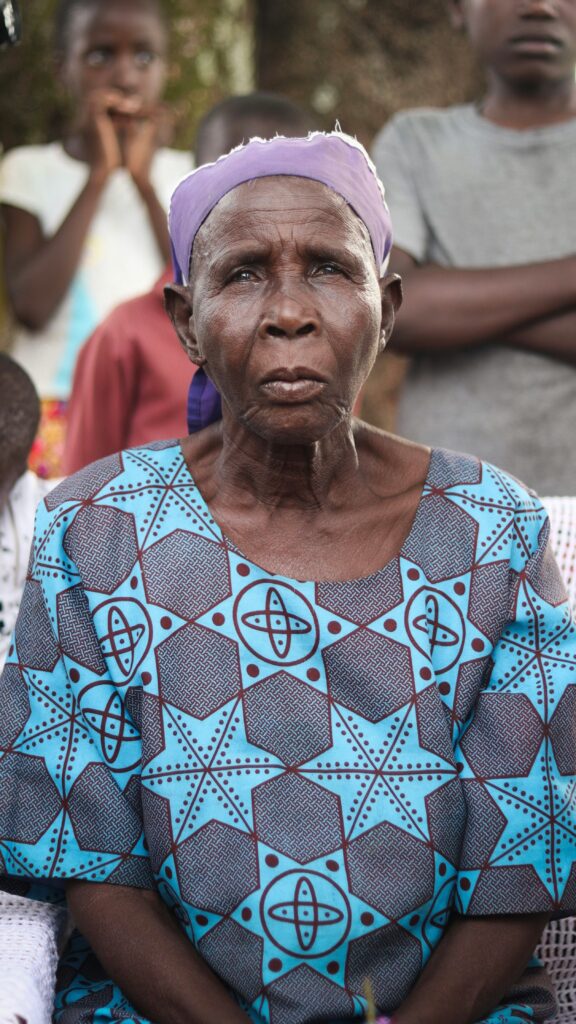
An older adult female was on the hospital bed. She could not move much on her own. Her breathing was laboured, rapid, each breath an effort she was losing. Dry skin. Eyes heavy. She had the look of someone whose body had been making decisions without her for a while. Fifteen steps away, her two daughters were in the corridor, pacing and speaking in low voices, unable to watch. The response was immediate. The lead provider issued instructions while leaning over the patient’s arm, her eyes narrowed in concentration. Another worked the IV line, glancing between the syringe and the clock on the wall, calculating. The third charted observations from the monitor with what looked like relief on her face: something in the numbers had told her things were moving in the right direction. By the time the team had done what they came to do, the woman was breathing easier. She looked better than she had walking in. To Exor, the second provider, this was familiar ground. He had stood in rooms like this many times.
He picked up the chart afterward. What caught him was not the diagnosis. He had seen the presenting symptoms before. It was a single line near the bottom of the page, almost an afterthought. Her occupation. Her address. How many years she had lived alone. He read it twice. He looked up at her. She was steadier now, her chest rising and falling without the same desperation. Her name, he saw in the chart, was Serwaa. Something changed for him in that moment, though he could not have named it straight away. He went back through the record differently, looking for things that had no designated field. Where had she been getting her healthcare? What did a typical day look like for her? Who was at home when she was sick? The chart had no space for any of it. Exor was beginning to think those were exactly the questions that mattered most.
He pulled other charts. He compared addresses, occupations, clinic visit histories. A pattern appeared. Not dramatic, not sudden. The kind of thing you see when you start looking for it. He thought about how many times he had stood at a bedside, administered the right treatment, noted the improvement, and left knowing nothing about what had produced the crisis in the first place. What was lying in front of him was not simply a disease. It was the end of a long road. The question was what that road had looked like. He put the chart down and walked to the corridor.
The two daughters turned when they heard him. The younger one, Nawuni, pressed her palms together and gave a small bow. She and her mother had the same face. The elder, Abena, stood with her arms crossed, composed in the way of someone who has spent years being the steadiest person in the room. Exor told them what the team had done and how their mother was doing. Then he asked if they would help him understand something the medical record had not captured: her life before the ward, what it had looked like. They agreed. He told them they were not obligated and could stop whenever they wanted. He just needed to understand how she had arrived here.
Abena spoke first. Their mother had been living in Nakah, a farming community some distance from the city. She had come there from Fugey, a crowded urban neighbourhood, about two years after their father died, twenty-one years ago. She moved because she was sinking under debt. Raising three children alone had cost her more than she had. Eventually she left the children with Paa Jay, a brother of their late father, a decent man who agreed to take them in. She went to Nakah thinking it would be temporary. In Nakah, she lived in a single room — zinc roofing, no ceiling, heat that built up during the day and did not leave quickly. The road outside led to the Torsu river, which was where the community got their water. It was a busy road in the afternoons. Her room was small, shared with the tools of her trade: pots, bowls, stacked firewood — barely enough air moving through the one narrow window.
Serwaa had grown up in Kutu, working the land from early. She knew what it was to bend under load, to eat irregularly, to work in a sun that gives nothing back. After coming to Fugey with her husband and then later to Nakah alone, she sold kenkey. Nearly three decades of it, at Fugey market first, then in Nakah. Up before the city. Home after dark. Nawuni put it plainly: she could not afford to close her table. The pots were heavy. The fires burned long. She stood for hours every day on ground that was uneven and hard. Her knees had taken it. Her back. Her lungs. Exor could see some of it just in the way she held herself in the bed. She farmed in Nakah as well, to manage the debt. The work did not ease as she got older.
Abena paused before she answered the next question. Her mother had not been herself for nearly a month, she said. She had been trying to manage it at home: herbs in the morning, rest between shifts at the table, telling herself she would be better by the following day. She had always believed the hospital was for people who could afford to be sick. Nawuni said their mother had stopped paying the insurance premiums eighteen years ago. The market was not giving her enough to cover them. Exor did not take notes. He thanked them and went back inside. The chart was accurate. It just did not contain very much of the story.
He could not look at the ward the same way after that. He moved from bed to bed more slowly, reading things he had not paid attention to before. The woman in the next bed had run a provisions kiosk for twenty-three years and had not been to a doctor in eight. The man across from her was a mason. One room in a compound house. The clinic he could afford was not the closest one. His hands had the look of hands that had worked past what they were built for. At the far end of the ward, an old man who had farmed cassava his whole life had spent three weeks treating chest pain at home with herbs and prayer before someone brought him in. Most of them had waited. On almost every chart, the line for insurance was blank. The charts said what was wrong with people. What they did not say was the rest of it. The ward was full of Serwaas.
Clinical training teaches the body. It teaches what goes wrong and how to fix it. What it does not teach is what the body carries in before anyone examines it. Serwaa’s illness did not start the morning she could not breathe properly. It started in a room with a zinc roof and a narrow window, at a market table she could not leave, beside a river that should not have been anyone’s only drinking water. It was not misfortune. It was structure: the shape of a life built in conditions that were always going to cost her something.
Exor went home that evening and sat in the dark for a long time. He had gone into work that morning thinking about treatment. He left thinking about something harder. Serwaa had arrived at the hospital at the end of a road. The question he could not put down was who had been paying attention to that road and for how long and whether any of us were willing to start now.